Vegan Pizza Dough (Neapolitan)
If you are looking for an easy vegan pizza dough to make your homemade pizza, you are in the right place! This Italian Naples-inspired crust is incredibly light and airy, with a soft inside and crunchy outside. We have been perfecting it for years. We even provide three different ways to bake it, all delivering delicious pizzeria-style results!
Servings 3 25 cm (10-inch) pizzas
Calories 610kcal
Equipment
- Pizza peel
- Pizza stone
- Pizza oven
Ingredients
- 4 cup Pizza flour 00 type
- 1+¼ cup Water
- 1 tsp Dry yeast
- 1+½ tsp Salt
- Semolina flour for dusting
Instructions
Making the pizza dough
- Weigh your ingredients (flour, water, yeast, salt) for the desired result. In a large bowl, add flour and dry yeast. With a whisk, mix the two and loosen up the flour.
- Add lukewarm water to the bowl. Use a spatula to gently mix the flour with the water, scraping the side of the bowl from time to time. When it gets hard to mix it any further with the spatula (and most of the flour is already mixed), switch to using your hand. If you are using a kneading machine for this step, use it at a low speed.
- Continue to knead the dough for 4-5 minutes. Now add the salt and try to squeeze it into the dough, so it's mixed well. Continue to knead for another 5 minutes. The dough is ready when it no longer sticks to your hand, and it has a gluey texture (dough should not break apart easily when you pull it).
Proofing the dough
- I place the dough covered with plastic wrap and proof it at room temperature for at least 1 hour. The dough should double in size.
- Divide the dough into three smaller doughs using a knife or a dough scraper. Form dough balls with your hands by folding one side of the dough to the other side. Turn it 90 degrees and repeat the process. This way, you will have a smooth and tight dough ball surface.
- Add the three dough balls into three separate containers (spread some oil so the dough won't stick) and leave it there for 15-20 minutes. Or if you don't want to bake all the dough on the same day, you can put it in the fridge and store it there for up to 2 days.
Shaping a pizza crust
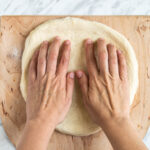
- Transfer one ball of dough to a flat surface dusted with semolina or cornmeal. Sprinkle the top with flour if needed (or simply just turn the dough upside-down). Use your fingertips to gently depress the round, stretching and pulling the dough gently into a circa 10-inch circle. For a bubbly outer crust, don't depress the outer circumference.
Baking on a sheet pan in the oven
- Preheat the oven to 390 Fahrenheit (200 degrees Celsius).
- Add parchment paper to a baking tray, and transfer the pizza crust with your hand to the tray. Gently arrange the crust back to a circle shape.
- Spread your sauce (No-Cook Pizza Sauce or Marinara Sauce), add your favorite toppings.
- Bake it for 10-15 minutes or until the outer crust gets some color.
Baking on a pizza stone in the oven
- Preheat the oven to 480 Fahrenheit (250 degrees Celsius) for at least 45-60 minutes. Place your pizza stone or steel to the highest position in your oven.
- Transfer the pizza crust with your hand to a baker's peel. Gently arrange the crust back to a circle shape.
- Spread your sauce (No-Cook Pizza Sauce or Marinara Sauce), add your favorite toppings.
- Turn on the top broiler in your preheated oven and transfer the topped pizza to your preheated stone or steel. Bake for 6-8 minutes until the crust is firm and charred in spots and the cheese is bubbling.
Baking in pizza oven
- Preheat the pizza oven to 840 Fahrenheit (450 degrees Celsius).
- Transfer the pizza crust with your hand to a baker's peel. Gently arrange the crust back to a circle shape.
- Spread your sauce (No-Cook Pizza Sauce or Marinara Sauce), add your favorite toppings.
- Transfer the topped pizza to your pizza oven. Depending on the exact type of your pizza oven bake for 1-4 minutes until the crust is firm and charred in spots and the cheese is bubbling.
Video
[adthrive-in-post-video-player video-id="qRwdTDC6" upload-date="2023-08-03T13:37:04.000Z" name="Vegan Pizza.mov" description="null" player-type="default" override-embed="default"]
Notes
In case you have questions about the recipe, please read the post above. No personal story will be there, don't worry. But I explain EVERYTHING in detail: why each ingredient is there, why each step has to be taken as written above, which substitutions will work and which won't, how to store the dough etc.
If you still have questions after that, drop us an email any time or leave a comment.
Fresh yeast vs active dry yeast
- Both in the US and in the EU, one packet of active dry yeast is 1/4 oz (7g). The one I use says on the package that 7g active dry yeast is equivalent to 25g fresh yeast, which is enough for 500g flour.
- In the US, one block of fresh yeast (like this one*) is 2 oz (57g), but in the EU, one block of fresh yeast is 50g. This difference will not affect the result.